Case study
How the Allard Prize Foundation built an AI donor-intelligence system — without starting with AI
An AI agent that watches a small list of high-value prospects and surfaces only the moments worth acting on. Built for a foundation promoting global integrity and anti-corruption work.
Most “AI for nonprofits” stories start with a tool and look for a use. This one started the other way around: with a small foundation that mapped its constraints, identified a single bottleneck — building fundraising capability — and only then asked how AI could help. The result is a system that does one job well, leaves judgment with the human, and runs for less than the cost of a streaming subscription.
This case study is the story of that build, told plainly. No promises that AI fixes fundraising. No claim that it replaces relationship work. Just an honest account of what worked, what it cost, and where the limits are.
The Allard Prize for International Integrity recognizes individuals and organizations fighting corruption and protecting human rights. It’s a small foundation with a big platform — three pillars: integrity, recognition, and the platform itself. Like most nonprofits, it has more relationships worth nurturing than people available to nurture them, and the cost of a mis-timed or generic outreach to a senior stakeholder is real.
Preet Noor leads the foundation’s donor cultivation. The prospects she tracks fall into a handful of categories: institutional funders, individual donors, connectors who can open doors, credibility nodes whose endorsement matters, and potential collaborators. Each category needs a different kind of attention. None of them want a “checking in” email.
The first principle of the project, in Preet’s words, was “we didn’t start with AI.” Together we walked through five steps:
- Map the core functions of the foundation.
- Identify the gaps between what the team needed to do and what it had capacity for.
- Prioritize — what would move the mission most?
- Name the immediate need — in this case, building fundraising capability.
- Then, and only then, ask how AI could help.
The point of that order is to keep the technology in service of the work. If we’d started with “let’s use AI,” we’d have built a chatbot or an email blaster — the obvious things. By starting with constraints, we identified the actual bottleneck: monitoring a small set of high-value prospects for moments when reaching out would be welcome and earned, rather than transactional.
The system has three parts: inputs, processing, and outputs.
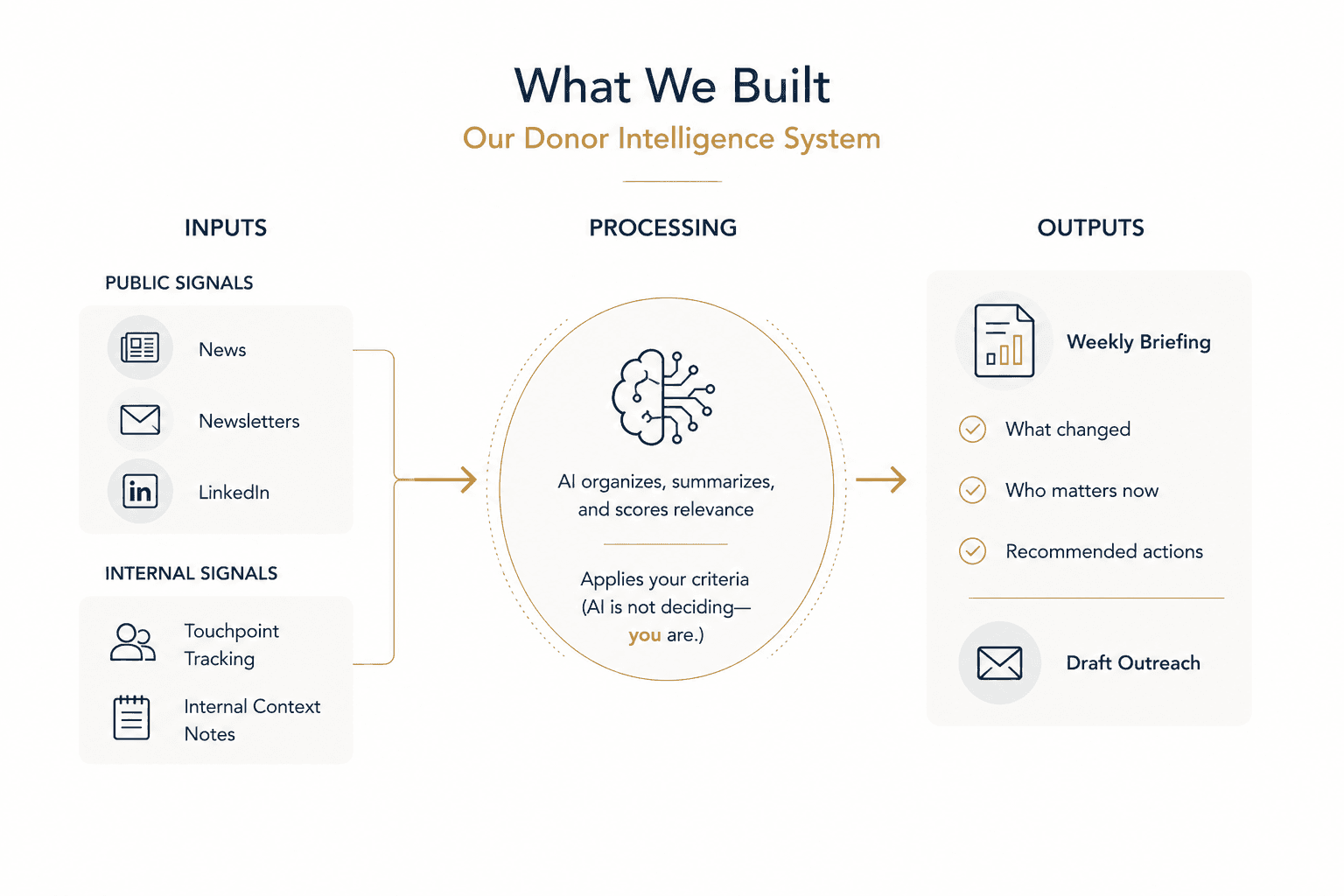
Inputs
The system watches each prospect through two kinds of signals:
- · Public signals — news mentions (via Google Alerts), newsletter posts, LinkedIn activity
- · Internal signals — a history of every touchpoint Allard Prize has had with the prospect, plus context notes Preet maintains
All of this lives in Google Sheets that Preet can inspect and edit. There’s no hidden database; if she wants to know what the system saw last week, she opens a tab.
Processing
Once a week, the system passes the captured signals through an AI agent. The agent’s job is to:
- · Interpret the relationship — is it dormant, warm, active, stalled?
- · Apply Preet’s criteria — different prospect types allow different kinds of outreach
- · Score the opportunity — on a 1–10 scale, how clearly is outreach justified right now?
The agent is built around restraint. Its first instruction is to default to no action — to recommend a touchpoint only when the case for one is clear. Anything scoring 7 or below is filed away. Only opportunities scoring 8 or higher surface to a human.
This is the part most “AI for outreach” tools get backwards. They’re optimized to generate messages. Ours is optimized to withhold them — because in donor relationships, the cost of a clumsy email to a senior person is far higher than the cost of saying nothing.
Outputs
When the agent finds a high-priority opportunity, the human gets:
- · A weekly briefing email — what changed, who matters this week, what’s recommended
- · A pre-written draft — a starting point for the outreach, tailored to the prospect type and the relationship state
The human reads it, edits it (or rejects it), and sends it from their own account. The AI never contacts a prospect directly. As Preet’s slide puts it: AI is not deciding — you are.
After several months of running the system, three benefits stand out:
- Better timing. Reaching people when something genuinely warrants it — not on an arbitrary cadence.
- Better judgment. A consistent filter applied to every prospect every week, instead of “whoever has capacity this Friday.”
- Better preparation. Walking into a meeting already aware of what the person has been doing, saying, and announcing.
Notice what’s not on this list: more outreach, faster outreach, automated outreach. The system’s value is not in volume — it’s in restraint and in quality of attention.
This is the part most case studies skip. We won’t.
- Time
- Mostly upfront — brainstorming, mapping prospect types, defining what “good” outreach looks like for each. Ongoing: a 1–2 hour prep block before each working meeting, every 1–2 weeks.
- Money
- Single-digit dollars per month for the AI calls. No CRM purchase, no enterprise platform.
- Maintenance
- Updating the prospect list, refining the criteria when the agent gets it wrong, watching for output drift. Not zero — but small.
The honest summary, again from Preet’s slide: AI is not plug-and-play. It requires intentional design and ongoing calibration. The model is the cheap part. The thinking around the model is the work.
A foundation that works on integrity has to take this seriously. Five principles shaped how the system handles data:
- · No sensitive donor data flows through the AI. The agent sees public signals plus internal context notes — written deliberately, not pulled from a CRM.
- · Inputs are public or controlled. News, LinkedIn, newsletters; or text Preet has chosen to put in.
- · Every output is reviewed by a human before anything reaches a prospect.
- · The AI’s boundaries are explicit. It doesn’t decide; it doesn’t send; it can’t access anything the human hasn’t given it.
- · An internal AI policy documents the above so it’s not reliant on any one person remembering it.
Safety by design. Trust by default.
The pattern — watch a list, filter for meaningful change, surface only what matters, draft something to act on — generalizes well beyond donor outreach. The same shape works for:
- · Content creation — drafting newsletter copy from research notes
- · Research & insights — summarizing what’s happening in a sector
- · Donor engagement — what we’ve described
- · Meeting support — preparing briefs from public information
- · Strategic planning — surfacing trends across a portfolio
- · Operations efficiency — automating low-value triage so humans can do high-value work
The Allard Prize system is one application of this pattern. Most nonprofits have at least three.
The system isn’t finished. Preet and the team are working in three directions:
- · System expansion — applying the same pattern to adjacent functions, starting with social-media content drafting.
- · System refinement — sharpening the donor-intelligence loop with better criteria, sharper scoring, and more useful briefings.
- · Internal ownership — running and improving the system in-house, rather than depending on outside help indefinitely.
That last point is the framing they put on it themselves: Building capability, not dependency. AI for nonprofits isn’t a project you ship and walk away from. It’s a relationship you maintain with a tool that’s powerful, fallible, and getting better only if you make it.
- Start with constraints, not tools. Map the work first. The right AI use case will be obvious; the wrong one will look obvious too.
- Build something small that respects judgment. A tool that drafts outreach for human review is a different beast from a tool that sends it.
- Bias the system toward restraint. If your AI’s default is to do something, it will do too much.
- Keep the data legible. Google Sheets are not a limitation — they’re a feature. Anyone on the team can audit what the system saw and what it concluded.
- Budget time, not just money. The dollars are small. The thinking is the cost.